8 Best Wireless Dog Fences for Large Areas (October 2026)
The best wireless dog fences for large areas include the Halo Collar 5 GPS dog fence for tracking across a large property, the Dogtra GPS Fence for custom boundaries without a subscription, and the PetSafe Guardian GPS dog fence for a home fence without tracking fees.
On this page (4 sections)
The best wireless dog fence for a large area is the Halo Collar 5, if you want GPS containment plus tracking and alerts. For a no-subscription setup, Dogtra offers custom boundaries for outdoor properties of 3/4 acre or larger.
A large lot changes the buying decision. Boundary shape, trees, phone service and whether you want tracking can matter as much as the stated range.
For a quick explanation of system types, read our GPS and wireless dog fence guide. If your acreage is uneven or has wooded edges, our guide to wireless fence range covers the signal limits to consider.
Our picks at a glance
-
1

-
2

-
3
 Best for a home fence without tracking fees
PetSafe Guardian GPS dog fence
8.1/10 our score
See it on Amazon
- 4
 Check it
PetSafe Guardian GPS 2.0 fence and tracker
Best for smaller properties with tracking - 5
 Check it
VERSMELO GPS fence with 2 collars
Best for two dogs and remote training - 6
 Check it
NQAPYQ GPS collar fence, 4 modes
Best for a simple adjustable radius - 7
 Check it
NBSUN portable GPS fence collar
Best for portable outdoor boundaries - 8
 Check it
RAINLEOTI GPS fence with polygon boundary
Best for app and remote control
Which wireless dog fences suit large areas?
The Halo Collar 5 is the strongest fit when a large property calls for tracking and multiple saved fences. Dogtra is the clearest no-subscription option among these picks, while the PetSafe models separate fixed home containment from tracking.
Halo Collar 5 GPS dog fence: Best for tracking across a large property
- Dual-frequency GPS
- Real-time tracking and alerts
- Multiple stored fences
- Subscription required
Halo combines GPS containment with location tracking and supports multiple saved fences. Its membership is required for GPS and fence features.
Pros
- Tracking and boundary alerts
- Multiple stored fences
- Training guidance included
Cons
- Membership required
- Description recommends charging nightly
Halo Collar 5 combines GPS containment with AlwaysOn GPS tracking and smartphone alerts if a dog approaches or crosses a boundary. Halo says its Precision+ system uses dual-frequency L1 and L5 satellites with real-time ground-station corrections, and describes accuracy within 2 ft.
The collar supports multiple saved fences, which may help if you need boundaries for more than one outdoor location. Halo says it updates location 20 times per second using Wi-Fi, Bluetooth and cellular connections.
The tradeoff is an ongoing membership requirement. Halo membership opens GPS tracking, virtual fence creation, unlimited cellular data, training guidance, live support and activity reports, so include that service commitment in your decision.
Halo also includes a training program with sound, vibration and optional static warnings. The description recommends charging nightly for best performance, so plan for a regular charging routine.
Choose Halo if you want containment and location updates in one system. If you mainly need a home boundary and want to avoid recurring fees, compare Dogtra or PetSafe Guardian GPS.
Dogtra GPS Fence: Best for custom boundaries without a subscription
- Circular or custom-shaped boundaries
- No monthly subscription
- Up to 30 stored fences
- Outdoor use on properties 3/4 acre or larger
Dogtra lets you draw circular or custom boundaries in its app, then the collar runs without a phone connection. It is designed for outdoor properties of 3/4 acre or larger.
Pros
- No recurring fees
- Custom-shaped boundaries
- App not needed after setup
Cons
- No live tracking or notifications
- Indoor use is not supported
Dogtra suits open properties where you want to shape the boundary around the land instead of relying only on a circle. The app supports circular or custom-shaped boundaries and can store up to 30 unique fences.
After setup, the collar operates independently, with no phone connection needed. Dogtra says the fence has no monthly fee, but it does not include live tracking or notifications.
The system is designed for outdoor properties of 3/4 acre or larger. Dogtra explains that smaller areas can compress the warning and safety zones, leaving less space for a dog to learn the boundary.
GPS performance still depends on the site. Dogtra says GPS is usually accurate within 3–15 ft and recommends setup in an open area with a clear sky view.
Choose Dogtra if custom boundaries and no recurring fees matter more than tracking. For help evaluating a larger lot's shape and coverage, see whether a wireless fence can cover 5 acres.
PetSafe Guardian GPS dog fence: Best for a home fence without tracking fees
- Designed for properties 3/4 acre or larger
- No subscription fee
- Tone, vibration or static settings
- Smartphone notifications
Guardian GPS is aimed at a fixed home boundary on a property of at least 3/4 acre. It has smartphone notifications and adjustable tone, vibration or static settings.
Pros
- No subscription fee
- Rechargeable collar
- App guided setup
Cons
- No tracking or portability
- Designed for dogs over 25 lb
PetSafe Guardian GPS is aimed at fixed home containment on properties of 3/4 acre or larger. It does not include tracking or portability, and PetSafe says there is no subscription fee.
The My PetSafe app guides fence setup and lets you monitor battery life, adjust collar settings and receive smartphone notifications. The collar offers tone and vibration or 10 levels of static, so you can select the warning approach that fits your training plan.
This model is designed for dogs over 25 lb, with neck sizes from 13 to 28 in. PetSafe says the collar can run for up to 5 days per charge, though actual battery time can vary with use.
Guardian GPS is a simpler choice if you want a home boundary without ongoing tracking service. If a dog’s location matters when it leaves the boundary, consider a tracker-equipped system such as Guardian GPS 2.0 instead.
PetSafe Guardian GPS 2.0 fence and tracker: Best for smaller properties with tracking
- Designed for properties 1/2 acre or larger
- Real-time tracking and push notifications
- Up to 50 custom fences
- Subscription required
Guardian GPS 2.0 combines a virtual fence with real-time tracking and supports up to 50 custom fences. A subscription is required, and cellular service is needed for tracking and push notifications.
Pros
- Tracking and boundary notifications
- Up to 50 custom fences
- Designed for 1/2 acre or larger
Cons
- Subscription required for each dog
- Dense tree cover can make it a poor fit
Guardian GPS 2.0 combines a virtual fence with real-time tracking and push notifications. It is designed for properties of 1/2 acre or larger, which gives it a lower stated minimum than the original Guardian GPS.
The MyPetSafe app supports up to 50 custom fences. A 2.4 GHz Wi-Fi connection is required for setup, and cellular service is needed for tracking and push notifications to function properly.
A subscription is required, including for each pet in a multi-dog household. PetSafe says the GPS fence remains active at all times, even when cellular service is unavailable, but tracking and notifications need that connection.
Dense tree coverage or a smaller yard may point you toward an in-ground or radio system. See our wireless fence options guide for a comparison of radio and GPS boundaries.
VERSMELO GPS fence with 2 collars: Best for two dogs and remote training
- Two receiver collars
- Fence and remote training modes
- No subscription fee
- Adjustable GPS boundary
VERSMELO includes two receiver collars and a remote for training, alongside GPS fence mode. Its adjustable boundary is stated as 75–2,997 ft.
Pros
- Two collars included
- Fence and remote training modes
- No subscription fees
Cons
- Designed for dogs 18 lb and above
- Remote and collars need charging
VERSMELO stands out for households with two dogs that also want a remote training function. It includes two receiver collars and one remote controller, with GPS fence mode and a separate training mode.
The adjustable GPS boundary is stated as 75–2,997 ft, and the remote control has a range of up to 900 ft. The system supports beep, vibration and static options, with adjustable levels for remote training.
VERSMELO says there are no subscription fees. The collars are designed for dogs 18 lb and above, and the stated fence-mode runtime is more than 40 hours after a 2.5-hour charge.
The remote training feature adds controls that a simple containment collar may not need. If your priority is a fence for multiple dogs, compare the system details in our guide to wireless fences for big dogs.
NQAPYQ GPS collar fence, 4 modes: Best for a simple adjustable radius
- Adjustable radius from 98–3,000 ft
- Four modes
- No monthly fees
- Outdoor use with strong GPS signal
NQAPYQ uses a saved center point and adjustable radius, with four modes and no monthly fees. It is intended for outdoor areas with a strong GPS signal.
Pros
- Wide adjustable radius
- Saved boundary settings
- No monthly fees
Cons
- Not for indoor or weak-signal areas
- Boundary is radius-based
NQAPYQ offers an adjustable radius from 98 to 3,000 ft with four modes: beep, vibration, static or protection. Its center point and radius save automatically, which makes a repeated outdoor boundary simpler to restore.
There are no monthly fees, wires or digging. The system is intended for outdoor use with a strong GPS signal, and its guidance says to avoid indoor or weak-signal areas.
The boundary is radius-based, so it may not fit a long, narrow property as closely as a custom polygon. Its instructions also describe a protection sequence that pauses correction after repeated triggers.
Choose it for an adjustable circular boundary in open space. For a rectangular or irregular yard, compare a system with custom boundary drawing instead.
NBSUN portable GPS fence collar: Best for portable outdoor boundaries
- Adjustable boundary from 64–3,280 ft
- Circular or polygonal fences
- No monthly fees
- Outdoor use
NBSUN supports circular or polygonal outdoor boundaries through a free app, with saved settings remaining active after the phone disconnects. Bluetooth range limits app connection and tracking.
Pros
- Polygonal boundary option
- No monthly fees
- Portable outdoor use
Cons
- Phone connection uses Bluetooth
- Tracking stops out of Bluetooth range
NBSUN provides adjustable boundaries from 64 to 3,280 ft and supports circular or polygonal fence shapes through its free app. Saved fence settings remain active after the phone disconnects.
The app connects by Bluetooth, and NBSUN says the collar must remain within Bluetooth range for tracking. Once it is out of range, tracking is unavailable, though the saved fence remains active.
The collar is designed for outdoor use and includes four modes: light, sound, vibration and static. NBSUN also gives an expected 36–48 hours of working time per charge.
Its polygon option may help with an irregular lot, but confirm the app and collar connection needs before relying on tracking. For a portable setup on trips, see our portable wireless dog fence guide.
RAINLEOTI GPS fence with polygon boundary: Best for app and remote control
- Custom polygon boundaries
- App and remote control
- No monthly fees
- Designed for open outdoor areas
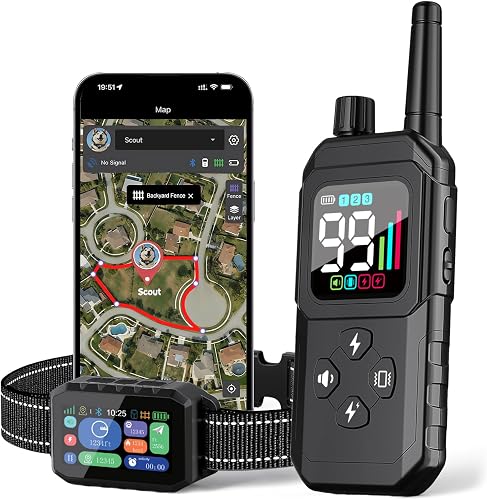
RAINLEOTI pairs polygon boundary setup in a free app with a handheld remote. It is intended for open outdoor areas where buildings and dense trees do not block GPS signals.
Pros
- Polygon boundary option
- App and remote control
- No recurring subscription
Cons
- GPS use is outdoor only
- App connection is about 100 ft
RAINLEOTI pairs custom polygon boundaries with app controls and an included handheld remote. The app connection is about 100 ft, while the remote range is stated as up to 1,640 ft.
There are no monthly subscription fees. The system is intended for open outdoor areas, and its guidance says to keep boundaries away from roofs, walls and dense trees that can obstruct GPS signals.
The collar supports up to five pet devices in the app and offers beep, vibration or static correction. Its stated active GPS use is about 20 hours per charge.
This option fits buyers who value both boundary setup and remote training controls. Since GPS needs a clear outdoor signal, measure a boundary that avoids buildings and heavy tree cover before settling on it.
What matters most on a large property?
For a large property, choose by boundary shape, GPS visibility and minimum usable area before comparing extra modes. A wide stated radius cannot compensate for poor satellite visibility or a boundary that does not match the land.
Does a large yard need a GPS fence?
A GPS system can suit a large yard when you want to set a virtual boundary without burying wire. Some models support custom shapes, while others use a radius around a center point.
Check the minimum property size and where the boundary can sit. Dogtra is designed for 3/4 acre or larger, Guardian GPS 2.0 for 1/2 acre or larger, and the original Guardian GPS for 3/4 acre or larger.
Will the boundary fit an irregular lot?
Custom polygon or freeform boundaries can better match an irregular property than a fixed circle. Dogtra, NBSUN and RAINLEOTI describe custom shaped boundary options.
A radius-based system can extend into a driveway, pond or neighboring land if the center point is not placed carefully. Sketch the safe area and any no-go zones before choosing a system.
How do trees and buildings affect GPS fences?
GPS fences need an open view of the sky for reliable positioning. Dense trees, roofs, walls and garages can obstruct signals or make a location less suitable.
Walk the proposed boundary at the times your dog will use it. If much of the yard sits under heavy cover, consider an in-ground wire system or a traditional fence instead.
What should you check before choosing a large-area fence?
Before choosing, confirm the smallest recommended area, the boundary shape, recurring service needs and what happens when the dog crosses the line. These details determine whether a system matches your property and the features you expect.
- Measure the usable outdoor area. Compare it with the maker’s stated minimum, not just the largest radius.
- Map the property shape. A circle may not protect a long rectangle or a yard with nearby roads.
- Check the signal path. Buildings and dense tree cover can interfere with GPS.
- Decide whether tracking matters. Containment alone may continue without cellular service, while live location and notifications can depend on service.
- Review the dog fit. Check collar sizing and weight guidance for each dog.
- Plan training and charging. Read the instructions and make time for boundary training and regular charging.
Our guide to large dogs and wireless fences covers collar fit and features for bigger dogs. If you are deciding between GPS and a wire system, our GPS vs wire dog fence comparison lays out the main tradeoffs.
Which wireless dog fence is the better fit for your acreage?
Choose Halo Collar 5 if you want GPS containment with location tracking, alerts and multiple stored fences, and you are comfortable with its required membership. Choose Dogtra if you prefer custom-shaped boundaries without a subscription and do not need live tracking.
For a fixed home boundary, PetSafe Guardian GPS avoids a subscription but does not include tracking or portability. For a smaller property with tracking, Guardian GPS 2.0 supports properties from 1/2 acre and adds real-time location features with a required subscription.
The best wireless dog fence for a large area is the one whose boundary fits your land and whose signal can work across it. Map the yard first, then compare system type in our guide to GPS and wireless dog fences.
Our top 3 picks at a glance
-
1
-
2
-
3
Best for a home fence without tracking fees
PetSafe Guardian GPS dog fence
8.1/10 our score
See it on Amazon
Frequently asked questions
Can a wireless dog fence cover a large area?
Yes, a GPS fence can define a virtual boundary across a large outdoor area, but the usable shape and minimum size depend on the system. Dogtra is designed for properties of 3/4 acre or larger, while Guardian GPS 2.0 is designed for 1/2 acre or larger.
Check the boundary type and signal conditions before choosing.
Is GPS or radio better for a large property?
GPS is often the more flexible choice for large or irregular properties because some systems let you draw custom boundaries. Radio systems use a transmitter-defined signal area, so the shape may be less suited to a long or uneven lot.
Our plain-English guide to GPS and wireless dog fences explains the tradeoffs.
Do GPS dog fences need cell service?
Some GPS fences need a subscription or cellular service for tracking and notifications, while containment may work without those features. Dogtra says its collar operates independently after setup and does not include live tracking or notifications.
Check the exact connectivity needs if you want to track a dog away from home.
Will a GPS dog fence work under trees?
Dense tree cover can weaken GPS performance, and some systems advise using them in open outdoor areas with a clear view of the sky. Guardian GPS 2.0 also notes that dense tree coverage may make it a poor fit.
Walk the proposed boundary and consider a wired option if the signal is obstructed.


