How Effective Are Invisible Dog Fences?
Invisible dog fences are highly effective for most dogs once training is done, though they are not a physical barrier. A radio wire or wireless boundary holds a dog that respects the warning zone, but it won't stop a determined dog that ignores the correction.
On this page (8 sections)
- How effective are invisible dog fences at containing a dog?
- Why does the type of fence change how well it works?
- How much range do you need for the fence to hold?
- How does training decide whether the fence works?
- Which systems make the boundary more reliable?
- What makes an invisible fence fail in daily use?
- How do invisible fences compare with a physical fence?
- How effective are invisible dog fences for your situation?
Invisible dog fences are highly effective for most dogs once training is done, though they are not a physical barrier. A radio wire or wireless boundary holds a dog that respects the warning zone, but it won't stop a determined dog that ignores the correction.
Effectiveness comes down to two things: a boundary that stays where you set it, and a dog that has learned what the warning tone means. Get both right and the fence does its job in daily use.
Miss either one and the dog learns it can push through.
How effective are invisible dog fences at containing a dog?
A trained dog stays inside a well-set boundary most of the time. The system warns the dog with a tone as it approaches the edge and only corrects if it keeps going, so the warning does most of the work.
That design is why containment holds up in everyday use. A dog that hears the tone and turns back never feels the correction, and the boundary becomes a cue rather than a punishment.
The same dog will usually stop at the edge even when it is excited by a squirrel or a passing dog.
The weak point is the untrained or hard-headed dog. A dog that has never learned the warning, or one that decides a correction is worth the reward on the other side, will cross.
Treat the fence as a strong deterrent for a trained dog, not as a wall.
One feature that quietly boosts effectiveness is static-free reentry. On a wireless system like the PetSafe units, a dog that crosses the boundary is not corrected again on the way back in.
That matters because a dog that gets zapped while returning may refuse to come home at all and just keep running. A boundary that lets the dog back in without punishment keeps the yard a safe place the dog is willing to re-enter.
Why does the type of fence change how well it works?
Wired and wireless radio fences are proven at containment, while GPS fences trade some precision for flexibility. Each boundary type behaves differently when the dog tests it.
A wired in-ground fence uses a buried wire to create a precise, fixed edge. It holds its shape around corners, garden beds and the driveway, and the boundary doesn't drift.
A wireless radio fence skips the digging and creates a circular zone from a transmitter, so it suits open yards but can't follow an irregular property line.
A GPS fence sets a virtual boundary through an app. It's the easiest to reshape, but its edge depends on satellite accuracy.
GPS is usually accurate within 3 to 15 feet, so a custom edge can wander by a few feet either way. For a closer look at how the two main styles compare, our guide to invisible fence vs regular fence covers the trade-offs against a physical fence.
How much range do you need for the fence to hold?
The boundary has to enclose the whole area your dog uses, with the warning zone inside your property. If the edge runs past your lot line, the dog gets corrected on a neighbor's lawn or near the road.
Wireless systems cover a circle measured from the transmitter, so placement matters as much as the top range. A unit rated to 1/2 acre reaches about 90 feet in every direction from the base, which is a circle roughly 180 feet across.
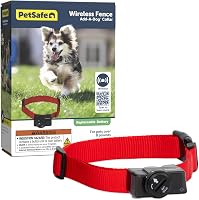
The PetSafe Wireless Dog Fence is rated up to 1/2 acre, and its circular range is adjustable from 5 to 90 feet. Its transmitter plugs into an outlet, so the circle starts wherever you place it.
If your yard is long and narrow or your house sits near the front, a circle may waste coverage or push the edge too far. Measure your lot before you buy.
Our guide to wireless dog invisible fence range explains how to translate a coverage figure into real feet.
How does training decide whether the fence works?
Training is the biggest factor in effectiveness, more than the hardware. A fence only works when the dog understands the warning, and that takes a few weeks of short, calm sessions.
Start with flags marking the boundary and the collar on tone only. Walk the dog near the edge and turn back when the tone sounds, then reward the turn.
Add correction levels only after the dog reliably responds to the tone, and keep sessions short so the dog stays relaxed. A collar with adjustable correction levels lets you start low and step up only if the dog needs it.
The PetSafe systems offer a tone-only mode plus five levels, so you can match the setting to the dog's temperament.
Rushing this stage is the usual reason a fence looks ineffective. A dog that meets the correction before it understands the tone may bolt through the boundary or refuse to go outside.
Dogtra recommends flag training and includes a training guide in the box. Owners who follow the flag-and-tone sequence usually see the dog respect the edge within a few weeks.
Which systems make the boundary more reliable?
Wireless radio units are the simplest to set up and hold a steady circular edge, while GPS units add custom shapes without buried wire. The right pick depends on your yard layout and how much precision you need.
Dogtra GPS Fence
Pick this for an irregular yard or a property of 3/4 acre or more where a circle won't fit. The app sets circular or custom-shaped fences, supports up to 30 boundaries and needs no monthly fee.
Each boundary can use tone, vibration or stimulation with 100 levels, and the collar works independently after setup. The IPX9K waterproof collar fits dogs 15 lb and up.
It's outdoor-only, so remove the collar indoors. Because the collar runs on its own after setup, the dog stays contained without a phone or WiFi connection in the yard.
PetSafe Wireless Dog Fence, up to 1/2 acre
This is the pick for a straightforward open yard and a dog that responds to tone training. It needs no digging, sets up in a few hours and runs on a waterproof collar that fits dogs 8 lb and up.
The circular edge is easy to check with the test light, and the static-free reentry means the dog isn't corrected on the way back in. It's also portable for camping or a vacation home.
One transmitter can be expanded with an additional unit if you need to push the boundary further, and extra collars let one system contain several pets.
PetSafe Stay & Play Compact wireless fence
Choose this one when you want more coverage from one transmitter and a clearer read on the edge. It adjusts up to 3/4 acre (22 to 105 feet in all directions) and the display shows the play area size plus any system error.
The rechargeable, waterproof collar fits dogs 5 lb and up. Setup still needs no wire, so it suits renters and yards with hard ground.
The display is the practical difference here, because you can confirm the boundary size without walking the whole edge first.
What makes an invisible fence fail in daily use?
Most failures come from a boundary that moved, a weak signal or a dog that never learned the warning. The hardware is rarely the problem on its own.
- A transmitter placed against metal siding or a large appliance distorts the field.
- A hilly yard or dense planting can create dead spots and uneven edges.
- A dead collar battery means no warning and no correction, so the dog walks straight out.
- A dog left outside unsupervised for long stretches finds the weak spot and tests it.
Check the boundary with the test light after any change to the yard, and replace collar batteries on schedule. A PetSafe collar battery lasts up to 2 months before the low battery indicator alerts you.
Test the edge at the same height as your dog's collar, not at your waist. The Stay & Play collar is rechargeable rather than battery-swapped, so keep its charger handy and top it up before the charge runs down.
How do invisible fences compare with a physical fence?
An invisible fence costs less and takes less installation time than a physical one, but it only contains a collared dog. A physical fence keeps other animals out and needs no training.
Choose an invisible fence when you want a quick boundary without digging or a visible barrier, and your dog is a good training candidate. Wireless radio systems set up in just a few hours, while a GPS fence needs only a few minutes in the app.
Choose a physical fence when you need to keep other dogs, wildlife or people out, or when your dog is likely to challenge the boundary. Some HOAs also restrict physical fences, which makes the invisible option practical.
Our comparison in do invisible dog fences work looks at the reliability question from the dog's side.
How effective are invisible dog fences for your situation?
For most trained dogs in a clear, well-measured yard, an invisible dog fence is very effective and reliable day to day. Pick a wireless radio system for an open circular yard, or a GPS fence for a custom boundary on a larger property.
Then commit to the flag-and-tone training, because that is what turns the boundary into a rule your dog follows.
The right collar matters too. Browse the dog collar for invisible fence options to match a receiver to your system and your dog's size.
Check the boundary every few weeks and fix weak spots before your dog finds them. A system that fits your dog's temperament and your yard's shape will hold up far better than one that fights either.
Frequently asked questions
Do invisible dog fences work for every dog?
No. They work best for dogs that respond to sound or vibration training and have a calm temperament.
Very stubborn, highly prey-driven or anxious dogs can push through, and the system is a poor fit for dogs that may panic at the correction.
How long does it take to train a dog to an invisible fence?
Plan on several short sessions over 2 to 4 weeks, with flags marking the boundary and a tone-only stage before any correction. Rushing the training is the most common reason a fence seems ineffective, so give the dog time to learn the warning zone.
Does an invisible dog fence keep other animals out?
No. An invisible fence only affects a dog wearing the collar, so it does nothing to keep other dogs, wildlife or people off your property.
If you need to keep animals out, you need a physical fence or another barrier.
What weakens an invisible dog fence?
Thick walls, metal siding, hilly ground, dense trees and a transmitter placed indoors near large appliances can all shrink or distort the boundary. Check the boundary with the test light before trusting it, and adjust the range or transmitter position if the edge is uneven.