How to Set Up a Wireless Dog Fence
To set up a wireless dog fence, place the indoor transmitter near an outlet, set the circular boundary, mark it with flags, and train your dog with the receiver collar. Check the signal around the whole edge before giving your dog access.
On this page (8 sections)
- What do you need before setting up a wireless dog fence?
- Where should you place the transmitter?
- How do you set the boundary and check its range?
- How do you mark the boundary with flags?
- How do you fit the receiver collar?
- How should you train your dog at the boundary?
- What should you do if the fence is not working as expected?
- Is a wireless dog fence the right fit for your yard?
To set up a wireless dog fence, place the indoor transmitter near an outlet, set the circular boundary, mark it with flags, and train your dog with the receiver collar. Walk the full edge to check the signal before letting your dog use the area.
A radio system needs a suitable transmitter spot and a boundary that fits your yard. Read the manual first, since placement, collar fitting, and training steps vary by system.
What do you need before setting up a wireless dog fence?
You need the transmitter, compatible receiver collar, flags, and the system manual. Choose a day when you can walk the yard and supervise several short training sessions.
Clear the proposed play area of hazards and decide where you want the boundary to run. Check gates, driveways, paths, and places where a dog might reach a road or another unsafe area.
A radio transmitter creates a circular boundary, so measure the usable space from the intended transmitter spot. Our plain-English guide to GPS and wireless dog fences explains how radio and GPS systems differ.
Where should you place the transmitter?
Place the transmitter indoors, near an outlet, and where the signal can spread toward the planned boundary. Follow the manual's instructions for clearance and nearby objects.
Start with a spot near the center of the area you want to contain. Keep the transmitter in a dry location and avoid placing it somewhere that could be bumped, unplugged, or blocked by everyday activity.
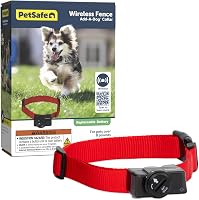
The PetSafe Wireless Dog Fence is designed for an adjustable circular range from its indoor transmitter, with coverage up to 1/2 acre. Its portable setup may suit a home or travel location with an outlet.
How do you set the boundary and check its range?
Set the transmitter's range control according to the manual, then walk the planned perimeter with the receiver collar to find where the warning begins. Do this at several points around the circle, not just near the transmitter.
Use a consistent pace and hold the collar at the height your dog will wear it. If the signal starts too close to the house or reaches an unsafe area, adjust the range or move the transmitter, then walk the edge again.
Can the signal cover the whole yard?
A radio boundary is circular, so check the circle against your usable yard before relying on it. The signal may not match long, narrow, or sharply angled property lines.
If the circle leaves a gap or includes a place your dog must avoid, a standard radio setup may not suit that layout. See wireless fence range and signal limits for more on coverage.
The PetSafe Stay & Play Compact has an adjustable circular boundary stated for up to 3/4 acre. Its transmitter has an LCD display showing how far the play area expands and warning indicators for system errors.
How do you mark the boundary with flags?
Place flags where the collar first gives its boundary warning, spacing them around the entire edge. Keep the markers visible from inside the play area so your dog can learn where to turn back.
Walk the perimeter again after placing the flags. Move any flag that doesn't match the warning point, and check areas near paths, corners, or objects that could affect how your dog approaches the boundary.
Leave the flags in place during training. Remove them gradually only after your dog reliably responds to the boundary cues, following the system's instructions.
How do you fit the receiver collar?
Fit the collar so the contact points touch the dog's skin without making the strap too tight. Follow the manual's guidance on contact points and fit, especially for dogs with long or thick fur.
Check the fit before each session. A collar that shifts or sits too loosely may not work as intended, while an overly tight fit can cause discomfort.
The PetSafe Wireless Pet Containment receiver collar is compatible with PetSafe Wireless Fence transmitters and includes short and long contact points. It's an add-on or replacement collar, not a complete fence system.
How should you train your dog at the boundary?
Train with short, supervised sessions that teach your dog to turn back before crossing the marked edge. Use the steps in your system's manual and give your dog time to learn the flags and warning cues.
Start inside the play area, approach a flagged edge together, and guide your dog back when the collar gives its warning. Repeat along different parts of the boundary so your dog learns the shape of the whole area.
Don't rush to unsupervised use. A wireless fence does not stop people, wildlife, or other dogs from entering, and it does not physically block your dog from leaving.
What should you do if the fence is not working as expected?
If the boundary is uneven or the collar does not respond as expected, check the outlet, transmitter settings, collar fit, and battery or charge status. Follow the manual's troubleshooting steps before changing the range.
Walk the perimeter again after any adjustment. Keep your dog supervised until you've confirmed the boundary works around the full intended area.
For a PetSafe system, see what to check when a PetSafe wireless fence is not working. For model-specific setup steps, use the PetSafe Stay & Play setup guide.
Is a wireless dog fence the right fit for your yard?
A radio wireless fence can suit a yard where a circular boundary fits the available space and an indoor transmitter can stay plugged in. If you need a boundary that follows irregular property lines, compare the radio, GPS, and hybrid wireless dog fence options.
Pick the 1/2-acre PetSafe system if its stated coverage fits your planned circle. Consider the Stay & Play Compact if its larger stated coverage and LCD range display match your setup, or add the compatible receiver collar when another dog needs a collar for an existing PetSafe Wireless Fence.
Before relying on any system, confirm the full boundary, fit the collar carefully, and train with supervision. If the circular signal cannot keep your dog within a safe area, choose a different containment plan.
Frequently asked questions
How long does it take to set up a wireless dog fence?
Allow a few hours for placement, boundary checks, flags, and the first training sessions. PetSafe describes its wireless systems as taking about 1–2 hours to set up, but your total time depends on the yard and how gradually you train your dog.
Follow your system's manual.
Where should I put a wireless dog fence transmitter?
Put the transmitter indoors in a dry spot with access to an outlet, following the manual's placement guidance. Choose a central location that gives the circular signal room to reach the intended boundary, then walk the whole edge with the receiver to check for gaps or changes.
Can a wireless dog fence cover a rectangular yard?
A standard radio wireless fence makes a circular boundary, so it may leave parts of a rectangular yard outside the play area or include areas you want excluded. Map the circle against your property before setup, and consider a wired or GPS option if the shape does not fit.
Should I leave my dog alone with a wireless fence right away?
No. Introduce the boundary with supervision and follow the training steps in your system's manual before allowing more freedom.
A wireless fence is a training aid, not a physical barrier, so stay nearby and use a secure leash or physical fence when needed.